



Fiberon™ PET-CF17
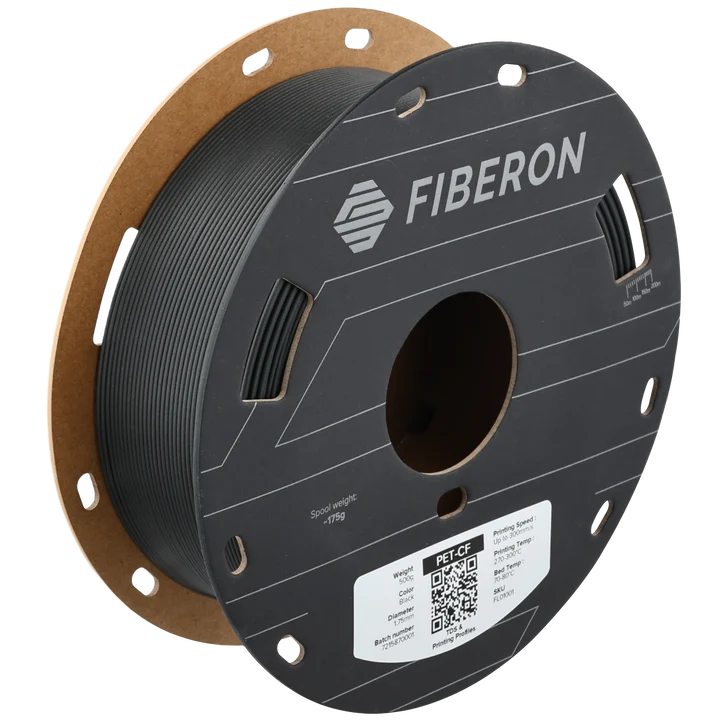
Engineered for high-rigidity structural parts, Fiberon™ PET-CF17 integrates 17% chopped carbon fiber into a PET matrix. It provides exceptional mechanical strength, minimal warping, superior heat tolerance, and low moisture absorption, making it an ideal choice for durable industrial components and end-use hardware.
Volume Pricing Available
Polymaker’s Fiberon™ PET-CF17 harnesses a 17% carbon fiber fill weight within polyethylene terephthalate to yield lightweight, rigid parts built for harsh operational demands. Unlike traditional nylon-based carbon fiber composites, this PET formulation absorbs significantly less ambient moisture, providing greater long-term dimensional stability and predictable prints without constant drying cycles. Boasting a tensile strength of 65.9 MPa alongside a 109.3 MPa bending strength in the primary print direction, this composite delivers the structural stamina necessary for metal replacement parts and high-load tooling. Its impressive 5.48 GPa Young's modulus ensures minimal deflection under load, while annealing pushes heat deflection temperatures up to 147.5°C for high-heat environments.
Key Benefits
Reinforced with 17% carbon fiber content for maximum stiffness and reduced component weight
High temperature resistance with an HDT reaching up to 147.5°C following post-annealing
Markedly lower moisture absorption rates compared to carbon-filled nylon materials
Exceptional dimensional precision with near-zero warping during the build process
High-speed print capabilities reaching up to 300 mm/s on modern motion systems
Attractive matte surface finish that conceals layer boundaries effectively
Excellent inter-layer bonding strength for dependable load-bearing capabilities
Prints reliably on open or enclosed machines without needing an actively heated chamber
Compatible with dedicated support materials such as PolySupport™ for PA12
Perfect for print farm environments requiring low failure rates and high output
Typical Applications
Drone structural arms, quadcopter frames, and custom gimbal mounts
Factory tooling, assembly jigs, holding fixtures, and robotic end-effectors
Enclosures and housings for sensitive electronic and mechanical systems
Prototype automotive components and lightweight structural brackets
High-stiffness mounting plates, linkages, and mechanical arms
Under-hood automotive accessories requiring heat and chemical resistance
Custom functional hardware replacing traditional CNC-machined metal stock
Prototypes exposed to elevated temperatures and outdoor elements
End-use parts needing dimensional accuracy under sustained mechanical loads Fiberon™ PET-CF17 excels in demanding engineering scenarios where low moisture pickup, high mechanical stiffness, dimensional fidelity, and thermal endurance are required.
Specifications Material: PET with 17% Carbon Fiber Filament Diameter: 1.75mm Available Weights: 0.5kg, 1kg, 3kg Available Colors: Black Density: 1.34 g/cm³ Nozzle Temperature: 270–300°C Build Plate Temperature: 70–80°C Maximum Print Speed: Up to 300 mm/s Cooling Fan: OFF (0%) Enclosure: Recommended (room temperature ambient) Nozzle: 0.4mm or larger hardened steel or ruby nozzle required Drying: 100°C for 10 hours if exposed to ambient air
Mechanical Properties
Tensile Strength XY: 65.9 MPa
Tensile Strength Z: 27.9 MPa
Elongation at Break XY: 2.4%
Elongation at Break Z: 1.0%
Bending Strength XY: 109.3 MPa
Bending Strength Z: 43.4 MPa
Bending Modulus XY: 4744.4 MPa
Young's Modulus XY: 5481.0 MPa
Young's Modulus Z: 3558.8 MPa
Charpy Notched XY: 5.1 kJ/m²
Charpy Unnotched Z: 3.1 kJ/m²
Thermal Properties
Glass Transition Temperature (Tg): 79.3°C
Melting Temperature: 241.3°C
Vicat Softening Temperature: 238.4°C
HDT @ 0.45 MPa: 147.5°C
HDT @ 1.8 MPa: 105.0°C
Recommended Print Settings
Nozzle: 270–300°C
Build Plate: 70–80°C
Print Speed: Up to 300 mm/s
Cooling Fan: OFF (0%)
Retraction Distance: 6mm (Direct Drive: 1–3mm)
Retraction Speed: 60 mm/s
Drying: 100°C for 10 hours prior to heavy printing runs
Nozzle: Hardened steel, tungsten carbide, or ruby tip (0.4mm or larger)
Enclosure: Recommended for minimizing thermal gradients on large structures Due to the abrasive nature of chopped carbon fibers, standard brass nozzles will degrade rapidly. To maximize thermal resistance up to the 147.5°C HDT limit and ensure full crystallization, parts should undergo a post-print annealing process at 120°C for 10 hours.