








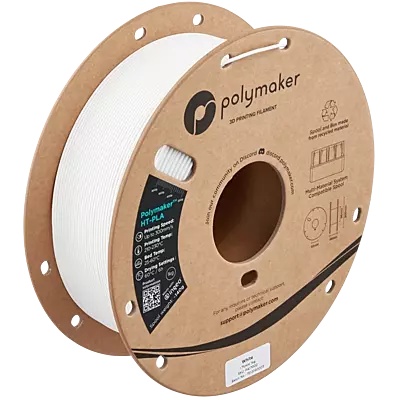
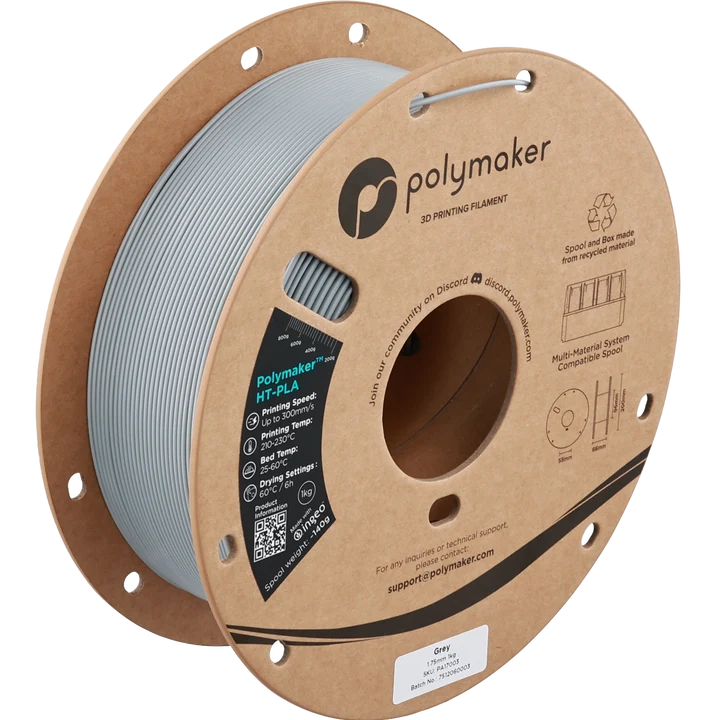
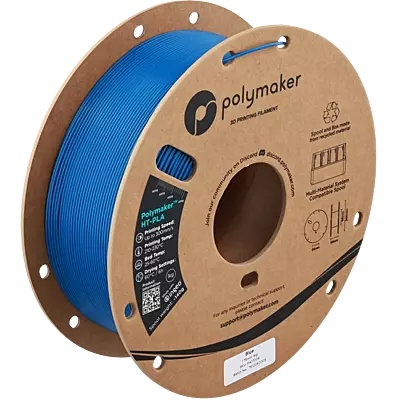
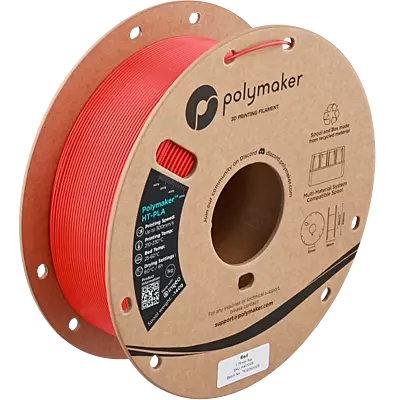
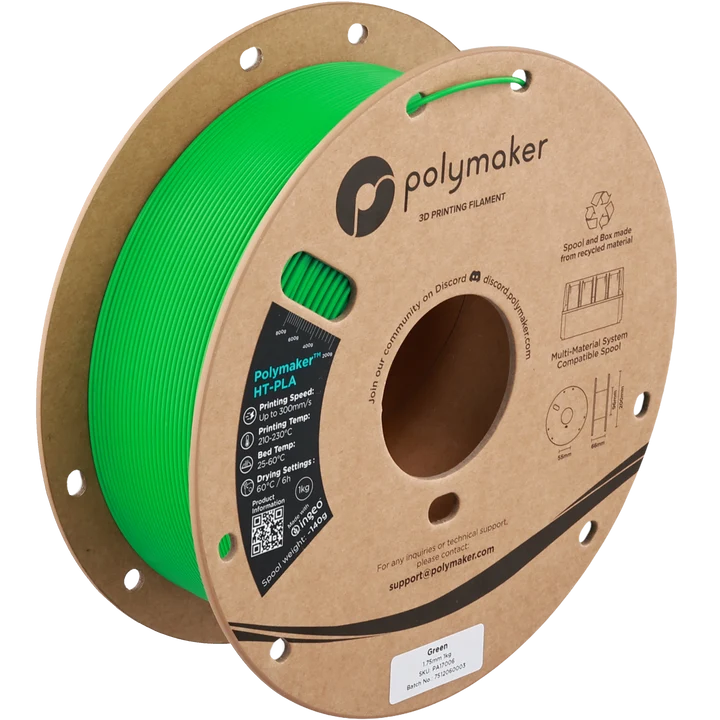
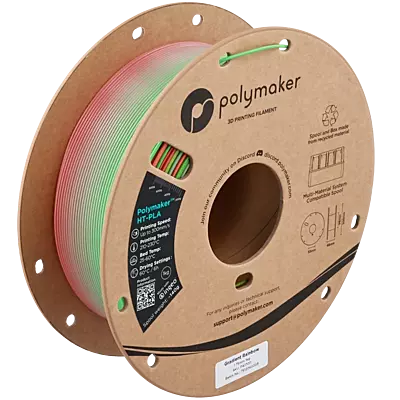
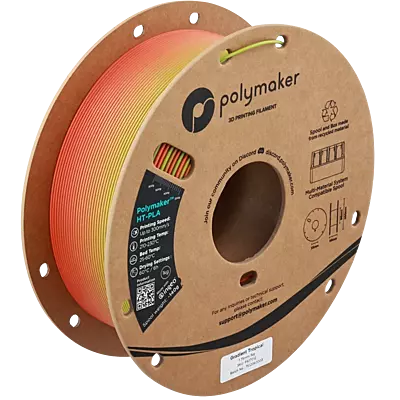
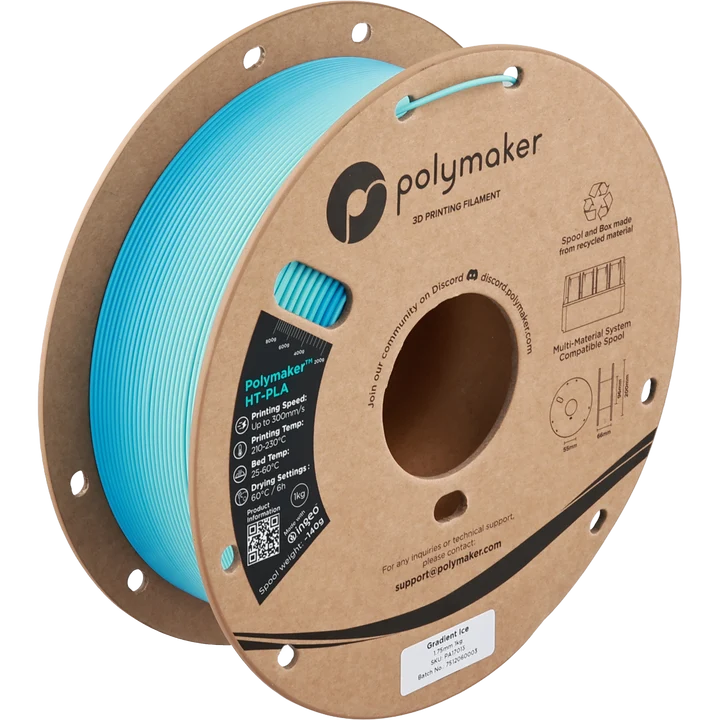
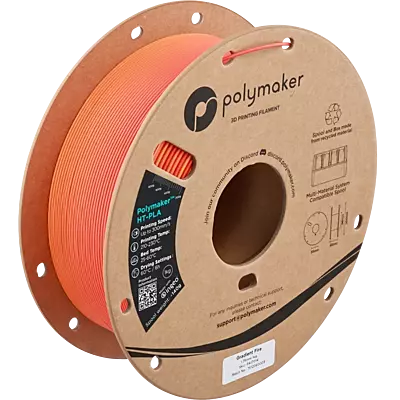
Polymaker™ HT-PLA
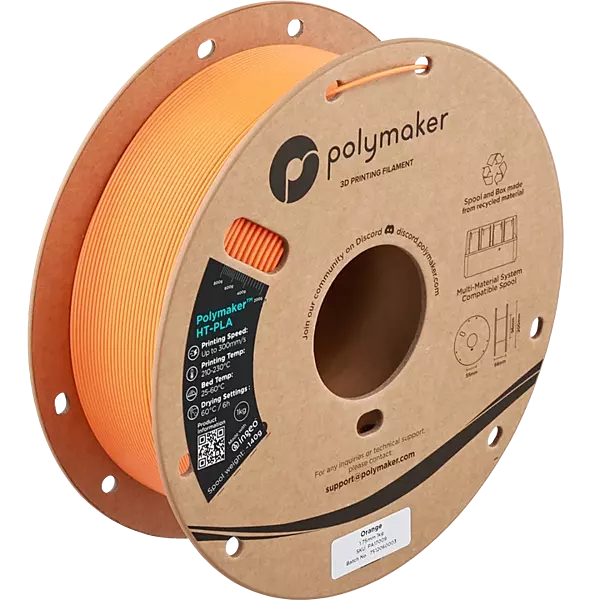
Polymaker™ HT-PLA is a high-temperature PLA filament designed to withstand temperatures up to 150°C while maintaining the easy printability of standard PLA. It supports high-speed printing up to 300 mm/s and requires no post-processing for typical applications.
Volume Pricing Available
Polymaker™ HT-PLA 1.75mm High-Temperature PLA Filament
Polymaker™ HT-PLA is a high-performance PLA filament engineered for applications requiring greater heat resistance than standard PLA while retaining the familiar ease of PLA printing. Designed to maintain its shape under elevated temperatures, HT-PLA can withstand temperatures up to 150°C under its own weight, making it well suited for functional parts exposed to elevated temperatures.
HT-PLA prints using standard PLA-style settings and does not require specialized printer upgrades or a heated chamber. With printing speeds up to 300 mm/s, it is also designed for high-speed FDM printing while maintaining excellent surface quality and dimensional stability.
For applications requiring increased heat stability, HT-PLA can be annealed at 80–100°C for 30 minutes, with 100°C recommended by Polymaker. Annealing can improve the material's heat stability and HDT performance.
Key Benefits
• High-temperature PLA formulation
• Heat resistance up to 150°C
• High-speed printing up to 300 mm/s
• Prints using standard PLA settings
• Easy to print
• No heated chamber required
• No post-processing required for typical applications
• Excellent surface quality
• Minimal shrinkage
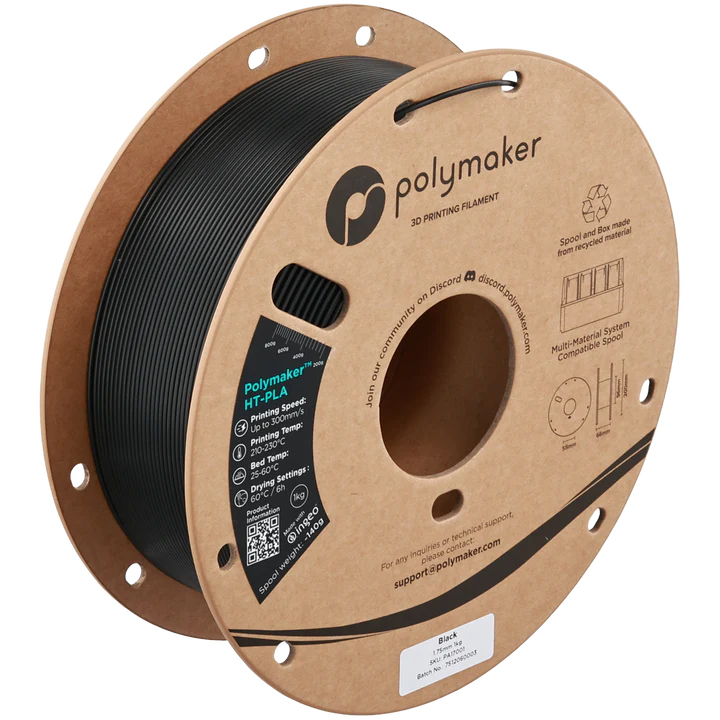
• Available in 14 colors
• Compatible with standard FDM 3D printers
Typical Applications
• Functional prototypes
• Automotive components
• Outdoor components
• Heat-exposed parts
• Engineering models
• Mechanical components
• Fixtures and tooling
• Housings and enclosures
• RC components
• Replacement parts
• High-temperature prototypes
• General-purpose functional parts
Polymaker™ HT-PLA is an excellent choice for applications where standard PLA is too temperature-sensitive but the easier printing characteristics of PLA are still desired. It provides a practical alternative to more difficult-to-print high-temperature materials while supporting fast, reliable FDM production.
Specifications
Material: High-Temperature PLA
Filament Diameter: 1.75 mm
Net Weight: 1 kg
Density: 1.287 g/cm³
Melting Temperature: 177.23°C
Glass Transition Temperature (Tg): 59.8°C
Vicat Softening Temperature: 156.2°C
HDT (1.8 MPa): 58.6°C
Mechanical Properties
• Young's Modulus (X-Y): 2945.75 MPa
• Young's Modulus (Z): 2596.43 MPa
• Tensile Strength (X-Y): 42.86 MPa
• Tensile Strength (Z): 20.83 MPa
• Elongation at Break (X-Y): 2.8%
• Elongation at Break (Z): 0.97%
• Bending Modulus (X-Y): 2893.46 MPa
• Bending Strength (X-Y): 74.04 MPa
• Bending Strength (Z): 29.39 MPa
• Notched Charpy Impact Strength (X-Y): 4.67 kJ/m²
Thermal Properties
• Heat Stability: Up to 150°C under its own weight
• Glass Transition Temperature: 59.8°C
• Melting Temperature: 177.23°C
• Vicat Softening Temperature: 156.2°C
• Heat Deflection Temperature (1.8 MPa): 58.6°C
• Annealing Temperature: 80–100°C
• Recommended Annealing Time: 30 minutes
• Recommended Annealing Temperature: 100°C
Recommended Print Settings
• Nozzle Temperature: 210–230°C
• Build Plate Temperature: 25–60°C
• Printing Speed: Up to 300 mm/s
• Cooling Fan: ON
• Retraction Distance: 1–3 mm
• Retraction Speed: 20–40 mm/s
• Chamber: Not required
• Drying: 60°C for 6 hours if material has absorbed moisture
• Annealing: 80–100°C for 30 minutes when increased heat stability is required
• Recommended Annealing Temperature: 100°C
• Hotend: All-metal hotend recommended
Additional Information
• HT-PLA is non-abrasive and does not require a hardened nozzle.
• HT-PLA has similar hygroscopic properties to generic PLA.
• UV and weather resistance are similar to generic PLA; no specific UV/weather modification is provided.
• HT-PLA is PLA-based and uses a multiphase composite structure.
• HT-PLA can be annealed in boiling water, although hard water may leave mineral deposits on the printed surface.
Note: Material shipment times are subject to PolyMaker warehouse stock and production times.